Universal Needle Cartridge Size Guide for PMU
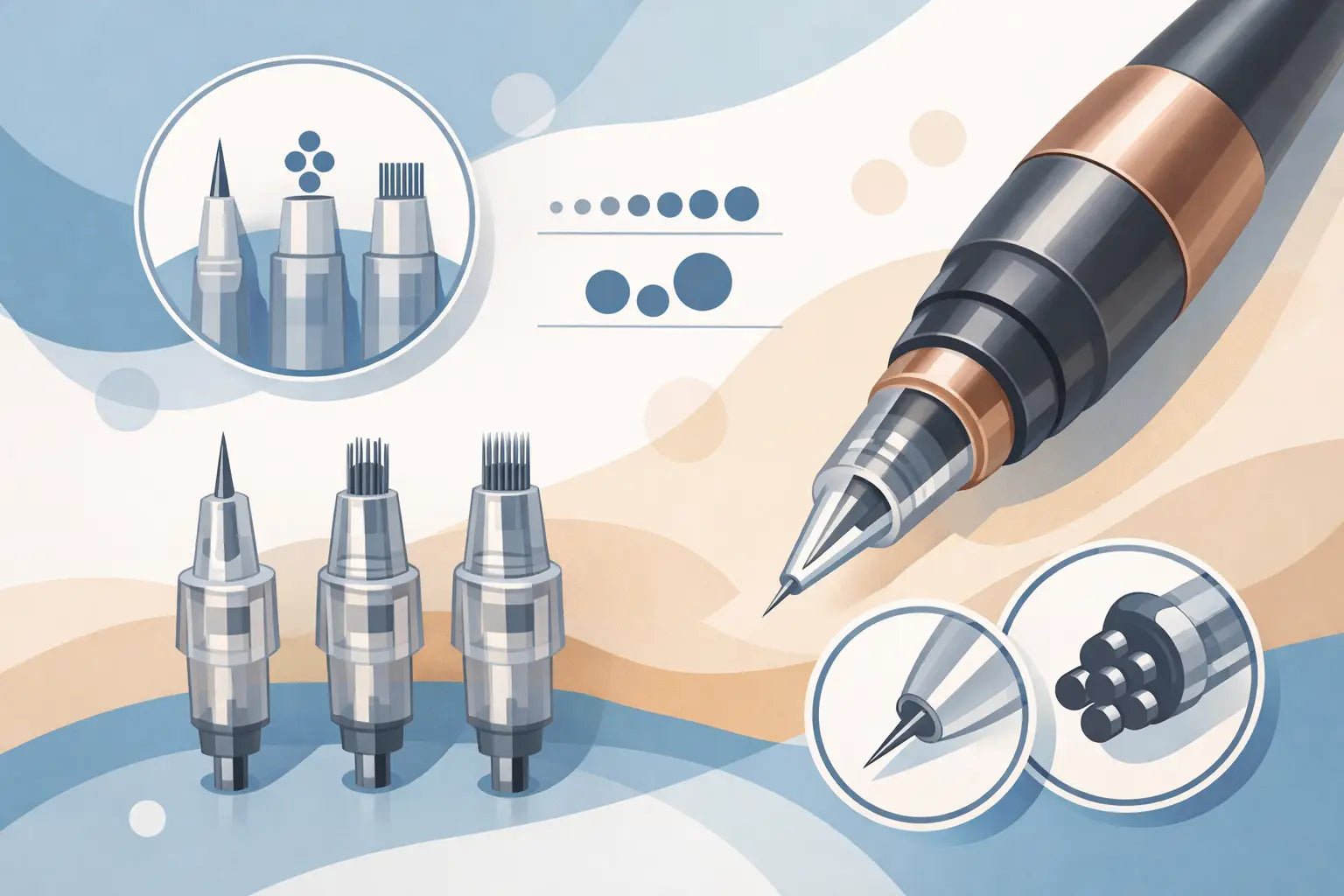
A cartridge labeled 0.25 1RL does not tell the full story, but it tells you where to start. This universal needle cartridge size guide breaks down the numbers and configurations PMU artists see every day, so you can choose cartridges with purpose instead of relying on whatever happens to be in your tray.
For cosmetic tattooing, needle selection affects more than line quality. It influences skin response, implantation depth, pigment flow, trauma, healing, and ultimately the softness or saturation of the healed result. The best cartridge is not simply the smallest, sharpest, or most popular option. It is the one that matches the treatment area, technique, skin condition, pigment, machine stroke, and your hand speed.
What “Universal” Means in Needle Cartridges
Universal needle cartridges are designed to fit machines with a standard cartridge connection, commonly called a Cheyenne-style connection. This makes it easier for artists to use compatible cartridges across many rotary and wireless PMU machines without changing their entire setup.
Compatibility is useful, but universal does not mean every cartridge performs the same. Needle soldering, membrane construction, tip design, stabilization, needle quality, and the amount of needle hang can vary by manufacturer. A 1RL from one professional brand may feel noticeably different from a 1RL made by another.
That is why experienced artists tend to standardize their core cartridges once they find a line that gives them predictable movement, pigment delivery, and skin response. Universal fit gives you options. Consistent product quality gives you control.
How to Read a Universal Needle Cartridge Size
Most cartridge labels combine a needle diameter, needle count, and configuration. For example, a 0.25 3RL identifies a 0.25 mm needle diameter, three needles, and a round liner grouping.
The order can vary slightly by brand, so always read the product label rather than assuming every naming system is identical. The key is understanding the three parts that determine how the cartridge behaves: diameter, grouping, and taper.
Needle diameter
Needle diameter is measured in millimeters. In PMU, common sizes range from 0.18 mm to 0.35 mm. A smaller diameter generally creates a finer puncture and can support delicate detail work. A larger diameter carries more pigment and can create stronger saturation, though it may be less forgiving on thin or reactive skin.
A 0.18 mm needle is extremely fine and is often selected for hair-stroke detail, crisp eyeliner accents, and artists who work with a light hand. It can be precise, but it also requires controlled technique because fine needles can be more sensitive to changes in speed, angle, and skin texture.
A 0.20 mm or 0.25 mm needle is a versatile working range for many PMU procedures. These sizes offer a balance of detail and pigment delivery, making them common choices for nano brows, machine hairstrokes, powder brows, lip work, and eyeliner depending on the configuration.
A 0.30 mm or 0.35 mm needle delivers more pigment and is often useful when building saturation in larger areas. They can suit powder brow shading, lip blush saturation, scar camouflage, or mature skin that does not retain color easily. More pigment flow is not automatically better, however. On fragile or thin skin, a larger diameter can create unnecessary trauma if your technique is not adjusted.
Needle grouping and configuration
The letters on a cartridge describe the needle arrangement. This arrangement changes the mark you make, the amount of pigment delivered, and how efficiently you can cover an area.
RL means round liner. These needles are grouped tightly in a circular pattern and are used for fine lines, hairstrokes, detailed brow work, beauty marks, and eyeliner. A 1RL is a single needle, while 3RL and 5RL use multiple needles to create a slightly wider, stronger line.
RS means round shader. The needles are arranged in a looser circle than a round liner, allowing for softer shading and more pigment distribution. Round shaders can work well for pixelated brow shading, lip blush edging, and compact detail shading where a magnum would be too broad.
F, or flat, means needles are arranged in a straight row. Flat configurations can create clean, controlled strokes and may be used for certain eyeliner, lip, or shading techniques. Their behavior depends heavily on needle count and hand angle.
CM, M1, or magnum-style configurations use needles arranged across a wider surface. Curved magnums are often favored for soft, even saturation because the curved edge can sit more gently on the skin. They are commonly used for lip blush, areola restoration, scar camouflage, and broader powder brow work. For facial PMU, smaller magnum groupings are usually more practical than large body tattoo configurations.
Taper
Taper describes the length of the needle point. A long taper produces a finer point and can feel more precise, while a shorter taper has a broader point that may deliver pigment more readily.
There is no universal rule that a longer taper is always better. Long-taper needles can be excellent for crisp detail and refined work, but they may require more patience and a more intentional hand. Medium or standard tapers can be a better fit when you need efficient saturation without repeatedly working the same area.
When comparing products, remember that taper terminology is not always standardized between brands. If you are switching cartridge lines, test the same configuration on practice skin before using it on a client.
Choosing Cartridge Sizes by PMU Treatment
For machine hairstrokes and nano brows, many artists start with a 1RL in 0.18 mm, 0.20 mm, or 0.25 mm. The right choice depends on the desired stroke width and the client’s skin. Oily, textured, or mature skin often needs a more conservative approach because ultra-fine detail can blur or heal unpredictably.
For powder brows and ombré brows, a 3RS, 5RS, small curved magnum, or a larger round configuration can support efficient pixel shading. A 0.25 mm or 0.30 mm diameter is often a practical range when you need smooth pigment placement without overworking the skin. Smaller groupings give you more control around the front of the brow and arch, while broader groupings can speed up saturation through the body and tail.
For lip blush, cartridge choice depends on whether you are outlining, blending the border, or saturating the lip tissue. A 1RL or 3RL can help define a soft vermilion border, while a 3RS, 5RS, or small curved magnum can build color more efficiently across the lips. Avoid treating the lips like brows: lip tissue is different, pigments behave differently, and a configuration that feels gentle on brow skin may not be the most efficient choice for lip saturation.
For eyeliner, fine round liners remain a staple. A 1RL is suited to delicate lash enhancement and precision detail. A 3RL may be more efficient for a soft, defined liner, especially when a client wants visible density rather than the most subtle result. Keep the client’s eyelid texture, desired style, and your machine settings in the decision.
The Trade-Off Between Fine Detail and Pigment Saturation
Smaller needles create refined marks, but they do not eliminate the need for proper technique. If a fine needle is not implanting efficiently, repeatedly passing over the same area can cause more trauma than choosing a slightly larger cartridge that delivers pigment cleanly.
Likewise, a larger grouping may speed up saturation, but it can take away precision in tight areas. The answer is often to keep more than one cartridge in your setup. For example, you may begin a lip procedure with a liner for detail, then move to a small magnum for controlled saturation. For brows, a smaller round shader may handle the front while a larger grouping supports the tail.
Build your setup around the treatment plan, not a one-cartridge habit.
Cartridge Safety and Setup Checks
Every cartridge should be single-use, sterile, and opened immediately before the procedure. Confirm that the packaging is intact, the expiration date is valid, and the membrane is functioning as intended. A quality safety membrane helps reduce the risk of backflow into the machine grip, but it does not replace correct barrier protection and cleaning protocols.
Before working on a client, inspect the tip under good lighting. Check that the needles move freely, sit centered in the tip, and do not appear bent or damaged. Run the cartridge at your intended machine settings on practice skin or another appropriate test surface if you are using a new brand or configuration.
Machine compatibility also deserves a quick check. Even when cartridges share a universal connection, the fit can feel different between machine grips. A secure fit, stable needle movement, and consistent needle hang are non-negotiable for precision PMU.
Build a Cartridge Kit That Supports Your Workflow
A practical PMU cartridge kit does not need every size available. It needs dependable options you understand well. Start with a fine round liner for detail, a versatile liner or round shader for controlled placement, and a small shader or curved magnum for saturation. Then expand based on the services you perform most often.
For artists building a new kit, prioritize professional-grade universal needle cartridges with clear labeling, reliable membranes, and consistent manufacturing. Inkbox Artistry sources PMU essentials with the working artist in mind, because the cartridge you choose should support your technique rather than force you to compensate for inconsistent performance.
The most useful size guide is the one you apply with intention at every appointment. Read the skin, match the cartridge to the service, and let healed results guide the refinements you make to your setup.