What Needles Fit Universal Cartridges?
If you have ever opened a new box of cartridges, looked at your machine, and paused for a second, you are asking the right question: what needles fit universal cartridges? In PMU, “universal” is helpful, but it is not a blank check. Most universal cartridges are built to fit rotary machines that use the standard cartridge connection, yet needle compatibility still depends on your machine’s give, stroke behavior, grip design, and the treatment you are performing.
For brow work, lips, liner, and small area paramedical applications, the wrong cartridge setup does more than feel awkward. It can affect pigment implantation, line consistency, trauma level, and client comfort. That is why experienced artists do not shop by the word universal alone. They look at fit, membrane quality, needle configuration, and how the cartridge performs under real working pressure.
What needles fit universal cartridges in PMU?
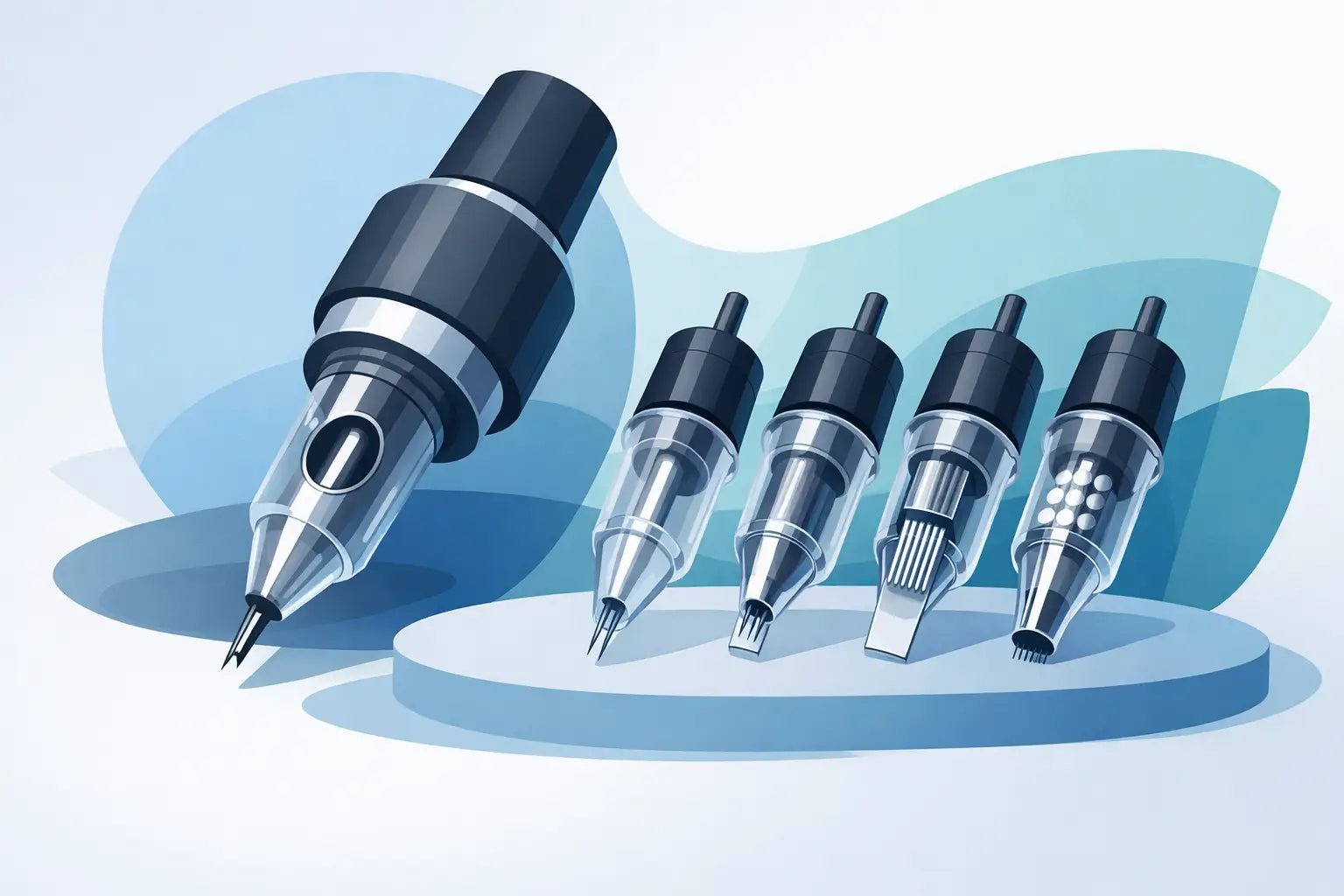
In practical terms, universal cartridges are designed to accept integrated needle groupings built into a standardized cartridge housing. That means you are not loading loose needles into the cartridge yourself. Instead, you choose a cartridge type such as a single needle, 3RL, 5RS, curved mag, or a PMU-specific nano configuration, and that complete cartridge is made to click into compatible rotary machines.
So when artists ask what needles fit universal cartridges, the real answer is this: needle configurations that are manufactured inside a universal-style cartridge body fit, provided your machine accepts the standard cartridge mount. Most modern PMU pen machines and many tattoo rotary machines do. Coil machines generally do not.
The word fit also needs a second layer of interpretation. A cartridge may physically lock into the machine, but that does not always mean it is the right performance match. Some machines run softer, some hit harder, and some have more give adjustment than others. A needle configuration that behaves beautifully in one machine can feel too soft or too aggressive in another.
Universal does not mean identical
This is where newer artists often get tripped up. Universal cartridges are based on a broad industry-standard connection, but manufacturers still build them with different internal tension, membrane resistance, shell shape, and needle taper options.
That matters in cosmetic tattooing because PMU is less forgiving than body tattooing in many cases. Brows need controlled saturation without blowing out the skin. Lips need smooth, even movement with minimal snagging. Eyeliner work demands stability and precision in a very small area. Two cartridges labeled with the same needle count can still perform differently if the internal build is different.
A 1RL from one brand may feel tighter and crisper, while another may run softer and suit shading better than line work. A nano configuration may be marketed similarly across brands, but the actual taper, needle diameter, and flow can change the result in skin.
The needle groupings most artists use with universal cartridges
For PMU professionals, the most common options inside universal cartridges are singles, round liners, round shaders, and selected magnum or curved mag groupings. Nano and very fine diameter cartridges are especially common in cosmetic tattooing because they support detailed implantation with less visible trauma when used correctly.
Singles and very tight round liners are often used for hairstroke-style work, pixel detail, fine outlining, and delicate definition. Round shaders are common for brows, lip blending, and softer powder effects. Magnum-style groupings can be useful for broader shading zones, though not every PMU artist prefers them, especially in facial work where smaller configurations often provide more control.
The best choice depends less on whether the cartridge is universal and more on your treatment goal, hand speed, machine settings, and the skin you are working on. Oily brow skin, mature skin, and dense lip tissue will not all respond the same way to the same cartridge.
Diameter and taper matter as much as fit
When evaluating what needles fit universal cartridges, do not stop at the grouping. Diameter and taper shape the result. A finer diameter can offer more precision and a lighter footprint, while a larger diameter may deliver more pigment but feel stronger in the skin. Long taper needles generally create a more refined implantation pattern, while shorter tapers can feel more direct and deposit color faster.
That is why professionals build cartridge options around service type rather than one-size-fits-all convenience. A setup that works for powder brows may not be your first choice for lip blush borders or lash enhancement.
How to know if your machine accepts universal cartridges
Most modern PMU machines marketed as cartridge machines are designed for universal cartridge compatibility. If your machine uses a twist-in or click-in cartridge system from the standard rotary format, you are usually in the right category.
Still, there are exceptions. Some devices use proprietary cartridge bodies, especially in highly brand-specific machine systems. Others may technically accept universal cartridges but perform best with certain cartridge shell dimensions or membrane tension. If you notice excessive wobble, poor depth consistency, or inconsistent needle hang, compatibility may be the issue even if the cartridge locks in place.
A good rule is to verify three things before stocking up: the machine’s cartridge connection type, whether the machine was designed for universal cartridges rather than a closed proprietary system, and whether the cartridge brand is known to run well in PMU machines rather than only in body tattoo setups.
Signs of a poor cartridge match
If the cartridge fit is off, you will usually feel it quickly. The machine may vibrate differently, the needle may not extend consistently, or the cartridge may have side-to-side movement that affects precision. You might also see inconsistent pigment implantation even when your technique is steady.
Another red flag is excessive resistance. If your machine suddenly feels underpowered with a cartridge that should be straightforward to run, the membrane tension may be too stiff for that device. On the other hand, a cartridge that feels too loose or too soft may not give you the control you want for crisp detail.
Why PMU artists should care about membrane quality
Membrane cartridges are standard for a reason. A quality internal membrane helps prevent backflow into the machine, which supports hygiene and protects your device. In a professional setting, that is non-negotiable.
But membrane quality also affects feel. A poorly built membrane can create drag, reduce consistency, or cause the cartridge to run unevenly. That is one reason many artists stay loyal to a handful of trusted cartridge brands once they find a setup that matches their machine and technique.
For suppliers created by permanent makeup artists for artists, this is not a small detail. It is one of the main reasons curated cartridge selections matter more than endless generic options.
Choosing the right universal cartridge for the service
For brows, many artists reach for finer liners or shaders depending on whether they are creating hairstrokes, powder, or a hybrid result. A softer shading technique usually benefits from a configuration that distributes pigment evenly without chewing up the skin.
For lips, smooth saturation matters more than brute force. Artists often prefer shaders or small groupings that move cleanly and allow controlled layering. Needle stability and taper become especially important here because lip tissue can expose flaws in cartridge quality fast.
For eyeliner, precision tends to lead the decision. Smaller, stable configurations are usually preferred because the treatment area is compact and unforgiving. In this category, a cartridge that technically fits but lacks stability is not worth the compromise.
A smarter way to think about compatibility
Instead of asking only what needles fit universal cartridges, ask what cartridge configuration fits your machine, your hand, and your service menu. Physical fit is the baseline. Functional fit is what protects your results.
That means looking at the cartridge as a full system: housing shape, membrane behavior, needle grouping, taper, diameter, and how it performs at your preferred voltage and hand speed. The artists who get the most consistent healed work are usually the ones who treat cartridge selection as part of technique, not an afterthought.
If you are building out your kit, start narrow. Test a few trusted configurations that align with the services you perform most. Track how they run in different skin types. Pay attention to how much pressure they require, how cleanly they implant pigment, and whether they give you predictable healing.
Universal cartridges make sourcing easier, especially for busy studios, trainers, and artists who want flexibility across machines. But the best setup is rarely the broadest one. It is the one that gives you clean fit, stable performance, and repeatable results behind the machine every single day.
When your cartridges match your machine and your treatment style, your work feels quieter - fewer adjustments, fewer surprises, and more confidence where it counts.